
Be sure to visit this page frequently for current events and opportunities. To learn about resources that are ongoing, visit our Resources page.
APAP 2015 – Through the Lens of Cultural Mobility
22 JanAs it does every year, New York in January provided a great time to watch, think about, and engage in discourse around dance and the business of dance. Between APAP and numerous other festivals occurring at the same time, New York becomes a hive of activity for performing arts professionals from around the world.
Three events – the Cultural Mobility Symposium, the APAP panel “Dance as an Outpost for America,” and the DanceUSA Forum – provided an intersection for several notes that I took regarding themes U.S. performing artists seeking more cultural mobility, particularly internationally, should perhaps examine and reflect on.
Power dynamics and empowerment
Obstacles for U.S. artists (from Outpost panel):
-At home they have to battle the idea that their work is not intrinsically valuable.
-They have to search for funding to survive domestically, much less tour.
-“Perhaps there is a lack of exposure to new ideas here” – another symptom of geographic isolation? Cultural mobility is essential to the health of the performing arts in the U.S.
It’s all about relationships – festivals, networking organizations, and so on.
-Festivals are wonderful for seeing work, but they are also beautiful for making introductions
-Networking organizations – such as IETM, On The Move, FACE – Fresh Arts Coalition Europe, and many others – are a great way to deepen your network without risking being “the tacky American”
-You have to travel. Americans by and large do not travel, which increases the effects of our geographic isolation. Connections must be made in person and work must be seen in person.
Politics
-By going to a country that is not your own you are an ambassador for your home country.
-Dance can be (and is often used as) a political tool.
-Moving against a monolithic “American dance,” “European dance,” etc. and towards solidarity and connecting artists with similar work across separate cultures.
More impressions from CINARS, Nov 18-21, 2014
15 DecBelow we have a guest blog from Jourdi Waller, Administrative Associate with the Stephen Petronio Company and an American Corner delegate to the 2014 CINARS Biennale in Montréal, Canada. Continue reading
Impressions from CINARS, Nov 18-21, 2014
24 NovBelow we have a guest blog from Amy Harrison, Managing Director of RIOULT Dance NY and an American Corner delegate to the 2014 CINARS Biennale in Montréal, Canada.
American Dance Recon/New York, November 5-10, 2014
19 NovOne of the best parts of my job is helping to host nine to eleven dance colleagues from around the world for 4-1/2 days during American Dance Recon, a yearly symposium around U.S. dance in a given city. ADR is invariably a rich week full of discussion, dance, and shifting perspectives. Continue reading
Tanzmesse
2 NovBelow we have a guest blog from Keila Cordova, Artistic Director of keila cordova dances/3 pony show and an American Corner delegate to the 2014 Tanzmesse. Continue reading
Rapid Response successfully funded at $10,000!
15 MayWe are grateful to announce that American Dance Abroad received $10,000 through its Indiegogo campaign for Rapid Response, a quick-turnaround micro-grant project to help U.S. artists respond to international invitations in time.
Rapid Response was created as a result of a gap we saw where many small and midsize companies were receiving a great deal of positive feedback and invitations to choreograph, teach, perform, or be in residence internationally, but were not able to meet those invitations due to a lack of funding. This often was not a huge amount of funding, usually just the costs of a few flights, but even that is too much risk for the already risky economics of a dance company. Moreover, the few noble organizations that do provide travel funding often necessarily require applications far in advance of the actual event. Invitations tend to pop up last minute, and we believe it can make an enormous difference in the expansion of the marketplace for U.S. dance if even a portion of those invitations can be answered.
That is why we were so thrilled to see a positive public reaction to Rapid Response through our Indiegogo campaign. Word spread slowly, but the campaign received a sharp spike of donations in its last week. The final count on Indiegogo’s site was $9,660, but American Dance Abroad also received several checks in the mail, totaling over $975 for a final tally of $10,635.
An enormous and collective THANK YOU to all of our contributors. Your support will help many artists work internationally.
Advance Audience Engagement Trip with Doug Varone, March 16-21, 2014
27 MarThis coming April, Doug Varone and Dancers will be performing in the Budapest Dance Festival at the National Dance Theatre (Nemzeti Táncszínház) in Hungary. They received support from several funding organizations including the Mid-Atlantic Arts Foundation’s USAI program, and conducted a very successful Kickstarter campaign for the remaining funds they needed – exceeding their goal. It’s especially exciting because they met the festival presenters at ADR/NY 2012 and the April performance is the result of that connection!
A Little Context
American Dance Abroad believes there is a three-part model for success for U.S. artists working internationally:
1. Connection. International colleagues and partners need to see work live in order to fully engage with American dance! Some U.S. artists have asked about “cold-calling” international presenters they don’t know, i.e. sending them emails with links to their work – this is a not a bad idea, but there always needs to be a personal connection for a successful collaboration to develop; there has to be the ability to contextualize work before it can be successfully presented. Most artists know this; it is doubly true for working across countries and cultures.
To build connections, American Dance Abroad brings small delegations of U.S. artists, managers, and agents to international performing arts marketplaces and festivals; and we also bring international colleagues to the U.S. for 4-1/2 day introductions to the dance scene in a single city (such as events in New York and San Francisco).
2. Availability. U.S. artists may be invited to an international festival, or may be invited abroad for a performance or residency, but how many companies have cash reserves that allow them to quickly accept that invitation? Especially with the short turnaround that often characterizes working abroad? The U.S., unfortunately, does not enjoy a supportive governmental infrastructure that connects our artists with international colleagues – especially for young and emerging artists. When invitations arrive, the biggest hurdle is finding the funds for transportation. Paid flights are the tiny bit of “bootstrap funding” that’s needed.
To help with this biggest obstacle to getting American dance abroad, we launched a project called Rapid Response (which you can read about here), and we’re doing an Indiegogo campaign to keep it running. Your donation can help the entire U.S. dance community! But hurry, because there are only 30 days left.
3. Audience engagement. If we expect international work to continue, it needs to be profitable and useful for both parties. Companies need to feel that their work is appreciated and programmers need to sell tickets. Everybody knows there’s immense value in cross-cultural exchange, but there are so many obstacles for U.S. artists to getting out of the country – distance, often a language barrier, lack of cultural know-how, among other things, but finding dedicated and informed audiences is also paramount.
You can’t have a profitable engagement without an interested audience. How do you build an audience abroad? The same way we do here: community work, master classes, lecture-demos, and publicity and promotion, including press conferences, which are not so common for dance in the U.S. All of which requires a little more funding and a little more work.
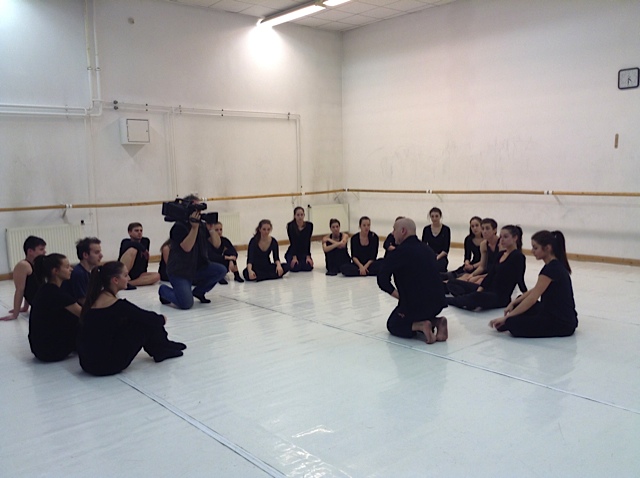
Doug Varone talks with students at the Hungarian Dance Academy after teaching.
Which brings us back to Doug Varone. American Dance Abroad supported an advance audience engagement trip this March. For five days, Doug gave master classes to the students at the Hungarian Dance Academy and the Budapest Contemporary Dance Academy, provided interviews for members of the local press (25 interviews over 4 days!), sat for a press conference and met with officials from the U.S. Embassy in Budapest. Although it was a short, no-frills trip, the response from the community was strong enough that the Festival and the Company have decided to add an extra day of master classes in April just prior to the company’s performances.
A little bit goes a long way.
Australian Performing Arts Market, February 18-22, 2014
9 MarTwo weeks ago, a U.S. delegation headed by American Dance Abroad traveled to Brisbane, Australia, for the 20th annual Australian Performing Arts Market. APAM 2014 brought a huge diversity of representation – hundreds of delegates, 37 full productions, and a number of showcases.
The February weather was in the 90s and humid, and not all the sites were air conditioned…the marketplace was a hot, sweaty flurry of networking and collaboration! There was a rapport in the air – informal introductions and easy banter, much friendlier than many other marketplace environments.
Included in the U.S. delegation were Andrea Snyder and Carolelinda Dickey, American Dance Abroad’s co-directors; Emily Wanserski, the managing director for Heidi Duckler Dance Theatre; Robert Moses (Robert Moses’ Kin); Olive Bieringa (co-director, the BodyCartography Project); and Stuart Pimsler (artistic director, Stuart Pimsler Dance & Theater).

American Dance Abroad delegation with ADR “graduates” in Brisbane
APAM marked the start of a collaboration between Heidi Duckler Dance Theatre and Topology, a Brisbane-based band called “Australia’s most surprising music organization.” They met when Emily (HDDT’s managing director) attended two international marketplaces with American Dance Abroad (the Tanzmesse and CINARS), where she met and began conversations with the managing director of Topology. During APAM, Heidi and one of her dancers began rehearsals with members of the band and shared an informal showing of the work in progress with an invited group of APAM attendees, including presenters from many other countries.
As always, the marketplace was full of networking opportunities, some expected and some surprising. Through Topology, Carolelinda and Andrea were introduced to the Director of Arts Queensland and began discussing ways to help develop and strengthen opportunities for Australian choreographers in connection with U.S. dance. They also had the chance to reconnect with Australian colleagues, including those who came to ADR/NY in 2013! Finally, the U.S. delegation was invited to a reception hosted by AusDance, the Australian national service organization for dance (the equivalent of Dance/USA).
Between making these connections – with presenters and colleagues from all over the world, not just Australia! – and viewing work featured at APAM, the delegates were very busy. Congratulations all on an inspiring and successful week.
Launching Rapid Response
7 JanAs 2014 begins, American Dance Abroad is pleased to announce the launch of Rapid Response, a quick-turnaround assistance program to support transit costs for U.S. dance artists in response to international invitations. Requests for support will be reviewed monthly. Requests received by the 15th of each month will have a decision by the end of the month. The program is designed as an aid for the artist to independently raise additional travel funds; amounts will generally range from $1,000-$2,500. To apply, go to: https://americandanceabroad.org/rapid-response-application/.
 American Dance Abroad